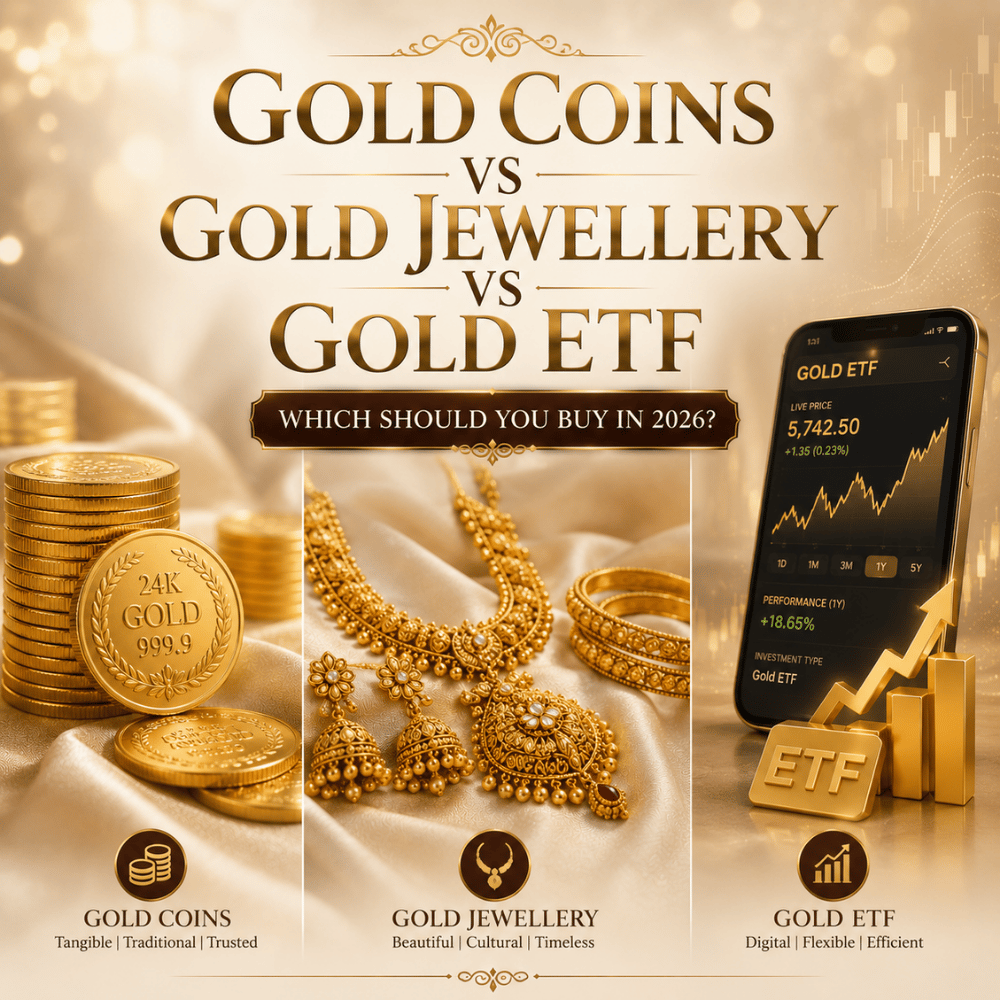
Gold Coins vs Gold Jewellery vs Gold ETF — Which Should You Buy in 2026?
India is the world's largest household holder of gold — estimated at over 25,000 tonnes sitting in homes, temples, and bank lockers across the country. Yet when it comes to buying new gold, most Indians face the same question: should I buy jewellery, coins, or go digital with a Gold ETF?
This is not a simple question. Each format of gold ownership serves a different purpose — and buying the wrong format for your goal can cost you significantly in the long run. A bride needs something different from an investor. A parent saving for a child's future needs something different from someone hedging against inflation.
In this complete guide, we compare gold coins, gold jewellery, and Gold ETFs across every dimension that matters — cost, returns, liquidity, storage, and suitability — so you can make the decision that is truly right for you.
Gold jewellery is the most traditional form of gold ownership in India. It combines the utility of an ornament with the value of a precious metal. Available in 18K, 22K, and 24K purities, jewellery is purchased from jewellers, worn for occasions, gifted at ceremonies, and passed down through generations.
The core advantage of jewellery is its dual purpose — it is both an asset and an accessory. Emotionally, no other form of gold comes close.
However, jewellery comes with a significant cost: making charges. These range from 8% to 25% of the gold value depending on design complexity. At the time of resale or exchange, making charges are not recovered. You are paid only for the gold content — meaning jewellery is the least efficient pure investment vehicle among the three.
Gold coins are 24K (99.9% pure) gold in standardised, certified form. Available from 0.5 grams to 100 grams, they are sold by banks, jewellers, and certified agencies like MMTC-PAMP. Making charges on coins are minimal (0-2%) compared to jewellery, making them far more efficient for investment.
Coins are BIS certified, easy to store, and widely accepted for resale or exchange across India. They also make excellent gifts — combining tradition with practicality.
The limitation: storage and security. Physical coins require a safe or bank locker, and insurance is advisable for large quantities.
A Gold ETF (Exchange Traded Fund) is a stock market instrument that tracks the price of physical gold. One unit of a Gold ETF typically represents 1 gram of 99.5% pure gold, held in secure vaults by the fund house.
Gold ETFs offer the purest investment play on gold price — no making charges, no storage risk, no purity concerns. They are bought and sold like stocks on NSE/BSE through a Demat account.
Alternatively, Sovereign Gold Bonds (SGBs) issued by the RBI offer gold price returns plus 2.5% annual interest — making them the highest-returning gold investment vehicle available in India.
The limitation: no physical gold. You cannot wear it, gift it as a tangible object, or use it for traditional ceremonies.